
USA
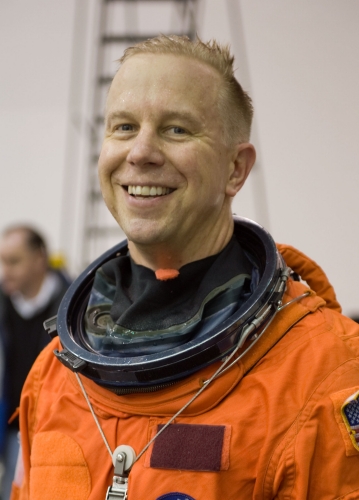
Timothy Kopra
(Timothy Lennart Kopra)
(Apr 09, 1963)
Astronaut 499
Astronaut of the USA 321
EVA astronaut 188
EVA astronaut of the USA 120
Spaceflights 2
EVAs 3
Spaceflights
| No. | Launch | Orbiter | Duration |
| 1st | Jul 15, 2009 | Endeavour STS-127 - ISS-20 - Дandmкаверand STS-128 | 58 d 2 h 50 m 15 s (1394 h 50 m 15 s) |
| 2nd | Dec 15, 2015 | Soyuz ТМА-19М - ISS-46/47 | 185 d 22 h 11 m 51 s (4462 h 11 m 51 s) |
| Cumulative time: | 244 d 1 h 2 m 6 s (5857 h 2 m 6 s) | ||
EVAs
| No. | Date | Orbiter | Duration |
| 1st | Jul 18, 2009 | ISS USA | 5 h 32 m |
| 2nd | Dec 21, 2015 | ISS USA | 3 h 16 m |
| 3rd | Jan 15, 2016 | ISS USA | 4 h 43 m |
| Cumulative time: | 13 h 31 m | ||
Astronaut Tim Kopra is leaving NASA after 20 years of service and two spaceflights. His last day of work was October 1, 2018.
Kopra, a native of Austin, Texas, and a retired U.S. Army colonel, was selected for the astronaut corps in 2000. He flew on two space shuttle missions and participated in two expeditions to the International Space Station.
In September 1998, Kopra was assigned to the Lyndon B. Johnson Space Center (Houston, Texas) as a space systems integration test engineer. In this role, he managed technical integration for space shuttle launch preparations and testing of space station hardware.
After being selected for the corps and completing initial astronaut training, Kopra worked in the Astronaut Office's Space Station Branch; there, he focused on testing crew-hardware interfaces for two station modules, as well as implementing auxiliary computing systems and an operational local area network.
On July 15, 2009, Kopra launched to the space station as a crew member of the *Endeavour* STS-127 mission. During Expedition 20, he served as a flight engineer: he performed one spacewalk (lasting 5 hours and 32 minutes), operated the station's robotic arms and the Japanese robotic arm, and conducted numerous scientific experiments. On September 11, 2009, he returned to Earth aboard the Space Shuttle Discovery (STS-128).
Kopra returned to the space station as a flight engineer for the Soyuz TMA-19M spacecraft and a member of Expedition 46; he subsequently served as commander of Expedition 47 from December 2015 to June 2016. During his 186 days in orbit, Kopra and his crewmates conducted a series of biomedical studies focusing on eye health, cognitive function, salivary marker analysis, and microbiome research. The crew also received four cargo spacecraft; one of these delivered the BEAM (Bigelow Expandable Activity Module) inflatable habitat module to the station, designed to demonstrate deployable habitat technologies. Kopra performed two spacewalks, spending a total of 7 hours and 59 minutes outside the station. The objective of the first spacewalk was to move the station's Mobile Transporter platform to a safe position. During the second spacewalk, Kopra participated in replacing a faulty voltage regulator, thereby restoring power to one of the station's eight electrical power channels. He returned to Earth on June 18, 2016.
In total, he spent 244 days in space across two missions, as well as 13 hours and 31 minutes during three spacewalks.
Kopra earned a bachelor's degree from the U.S. Military Academy at West Point, a master's degree in aerospace engineering from the Georgia Institute of Technology, a master's degree in strategic studies from the U.S. Army War College, and a Master of Business Administration (MBA) degree from Columbia Business School and London Business School.
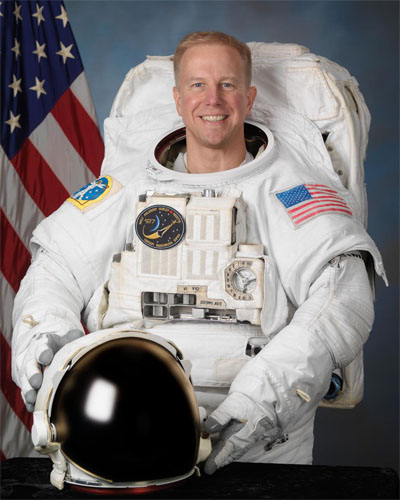
Timothy Kopra.
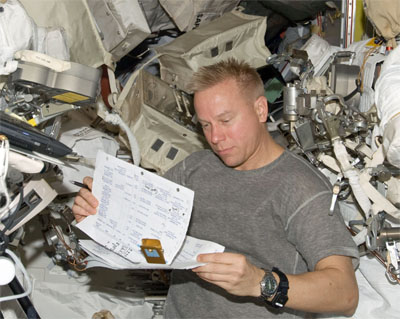
Timothy Kopra in the Quest airlock of the ISS.
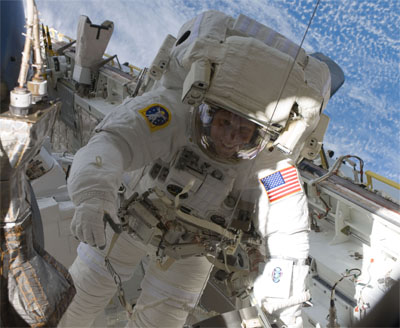
Timothy Kopra in outer space.
 Astronaut of the USA 320
 Astronaut of the USA 322
 Astronaut 498
Astronaut 500
Astronaut 498
Astronaut 500

 2001 Antropos.